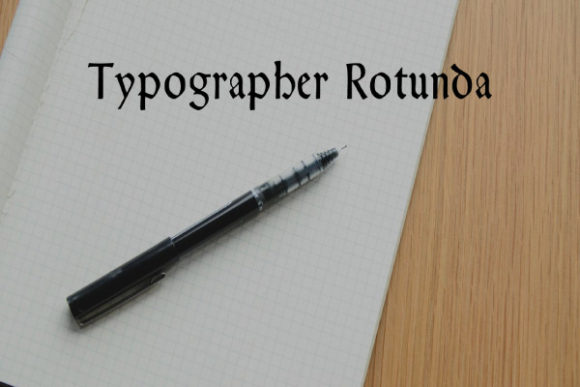
The Royal Aura of Typographer Rotunda: Why Blackletter Still Commands Attention
In an era dominated by clean sans-serifs and minimalist layouts, there is a distinct power in looking backward. There is a specific weight to history when it sits on your page or screen, demanding attention through its very structure. This is where Typographer Rotunda steps into the spotlight. It is not merely a font; it is an atmospheric device, a design choice that immediately signals authority, tradition, and a touch of the arcane.
Created by the renowned type designer Peter Wiegel, this typeface is more than just a digital recreation of historical scripts. It is a carefully crafted interpretation of the Rotunda style—a variant of blackletter that originated in medieval Europe. While many assume all old-style fonts look like jagged shards of glass, Rotunda offers a rounded, flowing elegance that feels both accessible and deeply mysterious. When you apply Typographer Rotunda to your work, you aren't just selecting a font; you are curating a mood.
Understanding the Roots of Rotunda
To truly appreciate the utility of Typographer Rotunda, one must first understand what it represents historically. Blackletter, often mistakenly referred to as "Gothic" in English-speaking countries, was the dominant script in Western Europe from the 12th to the 17th centuries. However, within this broad category, there were distinct regional variations.
Textura is the most recognizable form—vertical, dense, and highly structured. But Rotunda, originating in Italy and spreading northward, introduced a rounder, more cursive quality. The letters have curves rather than sharp angles, making them easier to read while retaining the ornate feel of their ancestors. Peter Wiegel’s version captures this essence perfectly. He has taken the historical skeleton and fleshed it out with modern precision, ensuring that the ligatures connect smoothly and the character shapes remain consistent across different sizes.
This historical context matters because it informs how users perceive the text. When someone sees Typographer Rotunda, they don’t just see letters; they subconsciously associate them with manuscripts, illuminated texts, and ancient decrees. That association is powerful. It lends an immediate sense of gravitas to whatever content it carries.
Aesthetic Qualities: The Mystical and the Royal
Why do designers reach for Typographer Rotunda? The answer lies in its dual ability to evoke royalty and mystery. The heavy strokes combined with the delicate inner details create a visual rhythm that is hypnotic. Unlike modern fonts that strive for invisibility—where the reader doesn't notice the typography at all—blackletter demands to be seen. It frames the content around it, acting almost like a decorative border even when used inline.
- The Roundness: The defining feature of Rotunda is its circular forms. This softens the aggressive nature of other blackletter styles, making it suitable for branding that wants to appear historic but not hostile.
- The Ligatures: Peter Wiegel paid close attention to the connections between letters. In Typographer Rotunda, these connections flow naturally, mimicking the hand of a skilled scribe. This adds a layer of craftsmanship that digital fonts often lack.
- The Weight: The typeface possesses a substantial presence. It doesn’t fade into the background. This makes it ideal for headlines, logos, and display text where impact is crucial.
Consider the word "Royal." If you set that word in Helvetica, it looks corporate. If you set it in Typographer Rotunda, it looks regal. The difference is stark. The font carries the visual DNA of crowns, castles, and royal seals. For projects aiming to establish a legacy or a sense of timeless value, this is an invaluable tool.
Modern Applications: Where Does It Fit?
You might wonder if such a traditional typeface has any place in modern web design or digital marketing. The answer is yes, but with strategic restraint. Typographer Rotunda is not meant for body copy. Reading long paragraphs in blackletter causes eye strain and reduces comprehension speed. Instead, its strength lies in its role as a display element.
Here are several practical scenarios where Typographer Rotunda shines:
- Brand Identity for Heritage Industries: Breweries, distilleries, and artisanal bakeries often use this style to communicate tradition and craft. A beer label featuring Typographer Rotunda instantly tells the consumer that this product respects old methods.
- Fantasy and Gaming: In the gaming industry, particularly for RPGs (Role-Playing Games) and fantasy novels, atmosphere is everything. Typographer Rotunda provides the perfect aesthetic for quest titles, chapter headers, and magical incantations. It bridges the gap between readability and immersion.
- Halloween and Themed Events: While often associated with horror, the "mystical" aspect of Rotunda makes it perfect for Halloween branding, occult-themed boutiques, or gothic literature events. It evokes the feeling of an ancient grimoire without being overly scary.
- Music and Entertainment: Bands in the metal, folk, or neofolk genres frequently use blackletter aesthetics. Typographer Rotunda offers a slightly more refined alternative to the harsher Fraktur styles, appealing to audiences who want edge but also elegance.
Practical Considerations for Designers
Using Typographer Rotunda effectively requires a shift in mindset. You cannot treat it like a standard sans-serif. Here are some key considerations to keep in mind when integrating this typeface into your workflow:
Contrast is Key
Because Typographer Rotunda is visually complex, it needs breathing room. Pairing it with a simple, clean sans-serif or a classic serif creates a beautiful tension. Imagine a bold headline in Typographer Rotunda followed by a paragraph of crisp, light-weight Arial or Garamond. The contrast highlights the beauty of the blackletter while ensuring the message remains clear. Without this balance, the design can become cluttered and difficult to navigate.
Kerning and Spacing
Peter Wiegel has done excellent work with the kerning pairs in this font, but human judgment is still required. Blackletter characters interact with each other in unique ways. The descenders and ascenders overlap in ways that modern fonts do not. Always check your text at various sizes. What looks good at 72pt might look cramped at 14pt. Adjust tracking (letter-spacing) generously. Giving the letters space allows their intricate details to breathe, enhancing the "mystical" quality rather than turning it into a muddy blob.
Color Psychology
The color you choose to render Typographer Rotunda changes its perception entirely. Black is the default, offering maximum contrast and seriousness. However, try using deep gold, crimson, or forest green. These colors enhance the royal and mystical associations. Gold suggests wealth and divinity; crimson suggests passion and danger; green suggests nature and alchemy. Experimenting with color can unlock new dimensions of meaning in your design.
Why Choose Peter Wiegel’s Version?
The market is flooded with blackletter fonts, many of which are poorly digitized scans of old books. They suffer from inconsistent stroke widths, broken glyphs, and awkward spacing. Typographer Rotunda stands out because it is a fresh creation inspired by history, not a direct copy. Peter Wiegel is known for his high standards in type design. His attention to detail ensures that every glyph—from the capital 'A' to the lowercase 'g'—is balanced and harmonious.
Furthermore, the versatility of this specific font family allows for multiple weights and styles. This flexibility means you can create hierarchy within your design. A bold version for main titles, a regular version for subtitles, and perhaps a lighter italic for emphasis. This range makes Typographer Rotunda a robust tool for comprehensive brand systems, not just a novelty item.
Conclusion: Embracing the Past for Modern Impact
In a digital landscape that often feels sterile and uniform, Typographer Rotunda offers a refreshing return to human craftsmanship. It reminds us that typography is an art form with deep roots. Whether you are designing a logo for a heritage brand, creating artwork for a fantasy game, or simply wanting to add a touch of mystique to a personal project, this font delivers.
It is not about rejecting modernity; it is about enriching it. By incorporating the royal and mystical appearance of Typographer Rotunda, you invite your audience into a story that feels older, deeper, and more significant. Use it wisely, pair it thoughtfully, and let its characters speak with the voice of history. In doing so, you elevate your work from mere communication to true expression.