Kasatriyan: Bridging Ancient Javanese Artistry with Modern Design Needs
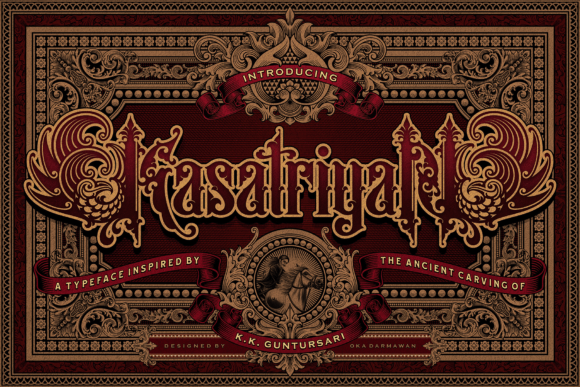
In the realm of typography, few typefaces carry the weight of history and cultural significance quite like Kasatriyan. It is not merely a font; it is a visual translation of heritage. This unique blacketter display typeface serves as an adaptation of the ancient carving motif known as Kanjeng Kyai Guntur Sari, a legacy attributed to the First King of Kraton Jogja (Yogyakarta). For designers, historians, and cultural enthusiasts alike, Kasatriyan offers a rare opportunity to integrate profound historical aesthetics into contemporary digital and print media.
Understanding Kasatriyan requires looking beyond its visual appeal to appreciate the craftsmanship behind its creation. The typeface captures the essence of traditional Javanese art, characterized by intricate curves, sharp angles, and a distinct sense of movement. Whether you are working on a branding project for a cultural institution, designing event materials for a traditional ceremony, or simply seeking to add a touch of elegance to a personal portfolio, Kasatriyan provides a versatile tool that respects its origins while functioning effectively in modern contexts.
The Historical Roots: Kanjeng Kyai Guntur Sari
To truly value Kasatriyan, one must first understand its source material. The typeface is directly inspired by Kanjeng Kyai Guntur Sari, an ancient carving motif. In Javanese culture, carvings are not just decorative; they are narrative tools that convey stories, spiritual beliefs, and social status. The First King of Kraton Jogja, who established the Yogyakarta Sultanate, left behind a legacy that is deeply intertwined with these artistic traditions.
The original motifs were carved into stone, wood, and other durable materials, serving both functional and aesthetic purposes. These carvings often featured stylized floral patterns, mythical creatures, and abstract geometric shapes that flowed together in a harmonious rhythm. When adapted into a typeface, these elements translate into letters that possess a similar fluidity and complexity. Each character in Kasatriyan feels hand-crafted, evoking the tactile sensation of running fingers over an ancient relief wall.
This connection to history gives the typeface an inherent authority and gravitas. When used in design, Kasatriyan does not just fill space; it tells a story. It connects the viewer to a lineage of artistry that has persisted for centuries. For businesses and creators operating in Indonesia or those targeting audiences interested in Southeast Asian culture, this historical resonance can be a powerful differentiator.
Key Features and Technical Specifications
While the aesthetic qualities of Kasatriyan are immediately apparent, its technical features ensure that it remains practical for everyday use. One of the most significant advantages of this typeface is its encoding standard. Kasatriyan is PUA encoded, which stands for Private Use Area encoding. This might sound technical, but for the end-user, it translates to ease of access and flexibility.
Accessibility Through PUA Encoding
Standard Unicode encoding has limitations when it comes to including every possible glyph, especially for specialized scripts or extensive ligature sets. By utilizing the PUA, designers can access all the glyphs and ligatures associated with Kasatriyan without worrying about compatibility issues across different platforms or software. This means that whether you are using Adobe Illustrator, Microsoft Word, or a web-based design tool, the full range of characters is available to you.
- Comprehensive Glyph Set: Access to all variations of the letters, including alternate forms that enhance visual interest.
- Rich Ligature Options: Special combinations of letters that flow seamlessly, mimicking the connected nature of traditional calligraphy.
- Cross-Platform Compatibility: Since PUA fonts are installed locally on your system, they work consistently across Windows, macOS, and Linux environments.
This technical robustness ensures that the beauty of the typeface is not lost due to software limitations. Designers can experiment freely with different character combinations, knowing that the intricate details will render correctly. It removes the friction often associated with using specialty fonts, allowing creativity to take center stage.
Visual Characteristics and Aesthetic Appeal
Kasatriyan is classified as a blacketter display typeface. Blackletter, historically associated with medieval European manuscripts, is characterized by dense, angular, and ornate letterforms. However, Kasatriyan reinterprets this classification through a Javanese lens. Instead of the rigid verticality of Gothic blackletter, Kasatriyan exhibits a more organic, flowing structure that reflects the natural world and traditional batik patterns.
The Interplay of Light and Shadow
The high contrast between thick and thin strokes in Kasatriyan creates a dynamic visual experience. The thick parts of the letters anchor the design, providing stability and presence, while the thin strokes add delicacy and refinement. This interplay is particularly effective in large-scale applications, such as posters, book covers, and signage, where the typeface needs to command attention from a distance.
Furthermore, the typeface includes numerous ligatures and contextual alternates. These are subtle changes in the shape of letters based on their neighbors, creating a more cohesive and unified word shape. In traditional calligraphy, ligatures are essential for maintaining rhythm and flow. In Kasatriyan, they serve a similar purpose, guiding the eye smoothly across the text and reducing visual clutter.
Practical Applications and Use Cases
Given its distinctive appearance and historical weight, Kasatriyan is best suited for specific types of projects where impact and identity are paramount. It is not recommended for long-form body text, as its complexity can hinder readability at small sizes. Instead, it shines in display situations where brevity and visual appeal are key.
Branding and Identity
For brands that want to evoke feelings of tradition, luxury, or authenticity, Kasatriyan is an excellent choice. Imagine a high-end restaurant specializing in Javanese cuisine using Kasatriyan for its menu headers. Or a boutique hotel in Yogyakarta incorporating the typeface into its lobby signage and promotional materials. In these contexts, the typeface reinforces the brand’s commitment to cultural heritage and quality craftsmanship.
Event Design and Invitations
Weddings, cultural festivals, and formal ceremonies often require stationery that conveys respect and elegance. Kasatriyan’s ornate nature makes it ideal for wedding invitations, event programs, and certificates. The typeface adds a layer of sophistication that plain sans-serif or serif fonts cannot achieve. It signals to the recipient that the event is special and thoughtfully curated.
Educational and Cultural Materials
Museums, galleries, and educational institutions can benefit greatly from using Kasatriyan in their publications and displays. When explaining historical concepts or showcasing artifacts, the typeface itself becomes part of the exhibit. It provides a visual context that complements the subject matter, helping visitors connect emotionally with the content.
Evaluating Suitability for Your Project
Before incorporating Kasatriyan into your design workflow, it is important to consider the specific needs of your project. While the typeface is stunning, it is a display font, meaning it is designed to be seen, not read extensively. Here are some guidelines to help you determine if Kasatriyan is the right fit:
- Scale Matters: Ensure that the typeface will be used at a size where its details are visible. Small text may appear muddy or illegible.
- Contrast is Key: Pair Kasatriyan with simple, neutral backgrounds and complementary sans-serif fonts for body text. Let the typeface be the star.
- Contextual Relevance: Consider whether the historical and cultural connotations of the font align with your message. Using Kasatriyan for a tech startup might create a dissonant effect unless carefully balanced.
- Ligature Management: Take time to explore the ligature options. Not all combinations may be visually pleasing, so manual adjustment may be necessary to achieve the desired look.
Considerations and Limitations
No typeface is perfect for every situation, and Kasatriyan is no exception. Its primary limitation lies in its versatility. Because of its highly stylized nature, it lacks the neutrality required for general-purpose communication. Attempting to use it for lengthy paragraphs or user interface elements would likely result in poor user experience.
Additionally, users should be aware of the learning curve associated with PUA encoding. While modern design software handles PUA fonts well, older systems or web browsers might require additional steps to embed the font correctly. Web developers, in particular, need to ensure that the font files are properly hosted and licensed for web use, as PUA fonts are primarily distributed for desktop installation.
Despite these considerations, the strengths of Kasatriyan far outweigh its limitations for appropriate applications. Its ability to convey depth, history, and artistry makes it an invaluable asset for designers looking to make a bold statement. By respecting its origins and using it judiciously, creators can harness the power of Kasatriyan to produce work that is not only beautiful but also meaningful.
Conclusion
Kasatriyan represents a remarkable fusion of past and present. It takes the ancient carving motifs of Kraton Jogja and transforms them into a functional, accessible, and visually striking typeface. For professionals and consumers alike, it offers a way to engage with cultural heritage in a tangible and creative manner. Whether you are enhancing a brand identity, designing an invitation, or simply exploring the boundaries of typographic art, Kasatriyan invites you to appreciate the beauty of history in every letterform.
As we continue to navigate a digital world dominated by uniformity, typefaces like Kasatriyan remind us of the value of diversity and uniqueness. They challenge us to look deeper, to appreciate the stories embedded in our visual language, and to create designs that resonate on a human level. In doing so, Kasatriyan does more than just display text; it preserves and propagates a legacy that deserves to be seen, read, and admired.