Unforgomen Blackletter Display Font: Bridging the Gap Between Medieval Tradition and Contemporary Design
In the vast landscape of digital typography, certain typefaces manage to transcend their aesthetic appeal to become cultural signifiers. Among these, blackletter fonts hold a unique position. Historically associated with the heavy ink strokes of medieval manuscripts and early printing presses, blackletter was once the standard for Western written communication. However, in the modern era, it has often been relegated to niche uses—think heavy metal band logos, Halloween decorations, or traditional brewery labels. Enter Unforgomen Blackletter Display Font, a contemporary evolution of this classic style that challenges old assumptions about readability and versatility.
This article explores what makes Unforgomen distinct, how its technical features like PUA encoding enhance usability, and why it is becoming a go-to choice for designers seeking to inject a sense of history and gravitas into modern projects without sacrificing clean, professional aesthetics.
Understanding the Evolution of Blackletter Typography
To appreciate the significance of Unforgomen, one must first understand the lineage of blackletter itself. Also known as Gothic script or Old English, blackletter originated in the 12th century. It was designed to maximize the use of parchment while creating a dense, unified texture on the page. Over centuries, various substyles emerged, including Textura, Fraktur, and Schwabacher. Each carried specific regional and cultural weights.
For decades, the primary criticism of blackletter in the digital age was its lack of accessibility. Traditional blackletter faces are often difficult to read at small sizes, making them unsuitable for body text or user interfaces. They were seen as decorative rather than functional. This perception limited their application primarily to display purposes where legibility was secondary to impact.
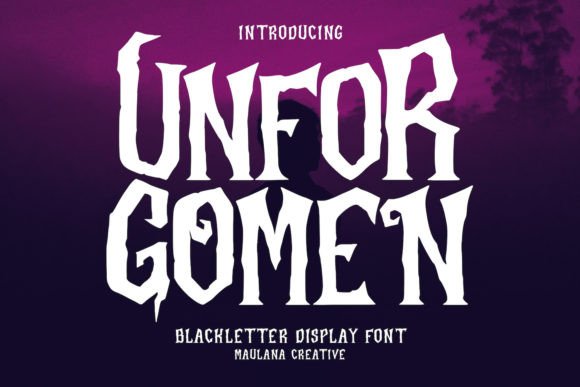
Unforgomen addresses this historical limitation by reimagining the blackletter form through a modern lens. It retains the dramatic, sharp angles and vertical emphasis characteristic of traditional calligraphy but refines the proportions to suit contemporary eyes. The result is a typeface that feels ancient yet fresh, powerful yet approachable.
The Unique Identity of Unforgomen
Unforgomen is not merely a revival; it is an adaptation. While it draws heavily from traditional calligraphic elements, it incorporates design principles common in modern sans-serif and geometric typefaces. This hybrid approach creates a visual tension that is highly engaging for viewers. The strokes are crisp, the contrast between thick and thin lines is balanced for screen viewing, and the overall structure is more open than its historical predecessors.
This balance allows Unforgomen to serve a dual purpose. It can act as a bold statement piece in headlines and logos, conveying strength and heritage, while remaining subtle enough to complement minimalist layouts. For brands looking to evoke trust, tradition, and authority—such as law firms, artisanal food producers, or educational institutions—Unforgomen offers a sophisticated alternative to generic serif fonts.
Technical Mastery: The Power of PUA Encoding
One of the most significant advantages of using Unforgomen in professional design workflows is its technical implementation, specifically its PUA (Private Use Area) encoding. To understand why this matters, we must look at how fonts interact with software and operating systems.
In standard font encoding, characters are mapped to specific Unicode values. However, many display fonts include additional glyphs, ligatures, swashes, and ornaments that do not have assigned Unicode codes. In older or poorly implemented fonts, accessing these special characters required complex workarounds, such as using third-party input tools or manually mapping character codes, which could break across different devices or platforms.
Unforgomen utilizes PUA encoding to solve this problem. The Private Use Area is a section of the Unicode standard reserved for custom characters. By assigning all its extended glyphs—including intricate swashes and alternate letterforms—to this area, Unforgomen ensures that every element of the font is accessible directly from your keyboard’s character map or within the glyph panel of design software like Adobe Illustrator or Photoshop.
Why PUA Encoding Matters for Designers
- Effortless Access: Designers can access all glyphs and swashes effortlessly without needing external plugins or scripts. This streamlines the creative process, allowing for rapid experimentation with different typographic combinations.
- Consistency Across Platforms: Because PUA-encoded characters are embedded within the font file itself, they render consistently across Windows, macOS, and mobile devices. This reliability is crucial for cross-platform branding materials.
- Expanded Creative Potential: The ability to easily swap standard letters for ornate swashes allows for greater customization. A designer can create a bespoke logo mark by combining specific glyphs, something that is often tedious with non-PUA fonts.
For experienced typographers, this level of control is invaluable. It transforms the font from a static asset into a dynamic toolkit, enabling the creation of truly unique visual identities.
Practical Applications in Modern Design
So, where does Unforgomen fit into today’s design ecosystem? Its versatility allows it to span several industries and mediums. Here are some practical examples of how this font can be utilized effectively.
Brand Identity and Logo Design
Logos require immediate recognition and emotional resonance. Unforgomen’s strong, classic feel makes it ideal for brands that want to project stability and timelessness. Consider a craft brewery launching a new line of premium ales. Using Unforgomen for the brand name evokes the imagery of traditional brewing methods and heritage, appealing to consumers who value authenticity. Alternatively, a high-end legal consultancy might use it for their monogram logo to convey authority and precision.
Editorial and Print Media
In magazine covers, book titles, and album art, Unforgomen stands out against lighter backgrounds. Its dark, dense forms create a striking visual anchor. For example, a true-crime podcast cover or a mystery novel title would benefit from the font’s slightly ominous yet elegant tone. It adds a layer of narrative depth before the reader even begins the content.
Digital Marketing and Social Media
While blackletter was once considered ill-suited for screens, Unforgomen’s modernized proportions make it viable for digital headers and social media graphics. When used sparingly for short phrases or quotes, it captures attention in crowded feeds. However, care should still be taken to ensure sufficient contrast and size to maintain readability.
Common Misconceptions About Blackletter Fonts
Despite its growing popularity, blackletter continues to face misconceptions that limit its adoption. Understanding these myths can help designers and clients make more informed decisions.
Myth 1: Blackletter is always illegible. As discussed, traditional blackletter can be challenging to read. However, modern interpretations like Unforgomen are designed with legibility in mind. The key is context; when used for headlines or short text blocks, it is perfectly readable.
Myth 2: It is only suitable for "edgy" or rebellious themes. While popular in rock and metal genres, blackletter has roots in religious texts, academic certificates, and official documents. Unforgomen taps into this broader history, making it appropriate for formal, academic, or luxury contexts.
Myth 3: It is too difficult to pair with other fonts. Some designers fear that the complexity of blackletter will clash with other typefaces. In reality, Unforgomen pairs exceptionally well with clean sans-serifs or simple serifs. The contrast between the ornate display font and a neutral body font creates a balanced hierarchy that guides the reader’s eye effectively.
Conclusion: Embracing the Fusion of Past and Present
The resurgence of interest in distinctive typography signals a shift away from the homogenized "Helvetica-ization" of global design. Consumers and audiences alike are craving authenticity and character. Unforgomen Blackletter Display Font answers this call by offering a typeface that honors the past while embracing the future.
Its combination of traditional calligraphic beauty and contemporary design sensibilities makes it a powerful tool for any creative professional. With the added benefit of PUA encoding, which ensures seamless integration into modern workflows, Unforgomen removes the technical barriers that once hindered the use of blackletter. Whether you are designing a brand identity, editing a publication, or crafting a digital campaign, Unforgomen provides the perfect blend of strength, elegance, and modernity.
By exploring the possibilities of Unforgomen, designers can unlock new dimensions of expression, proving that even the oldest forms of writing can find new life in the digital age. It is not just a font; it is a bridge connecting the rich heritage of calligraphy with the innovative demands of today’s visual landscape.